
The Next Up project is divided into different work packages, each focusing on different, complementary topics. Led by individual project partners, the work packages bring together different partner organizations depending on their specific areas of focus. The following pages provide an overview of the work package structure and the topics covered.
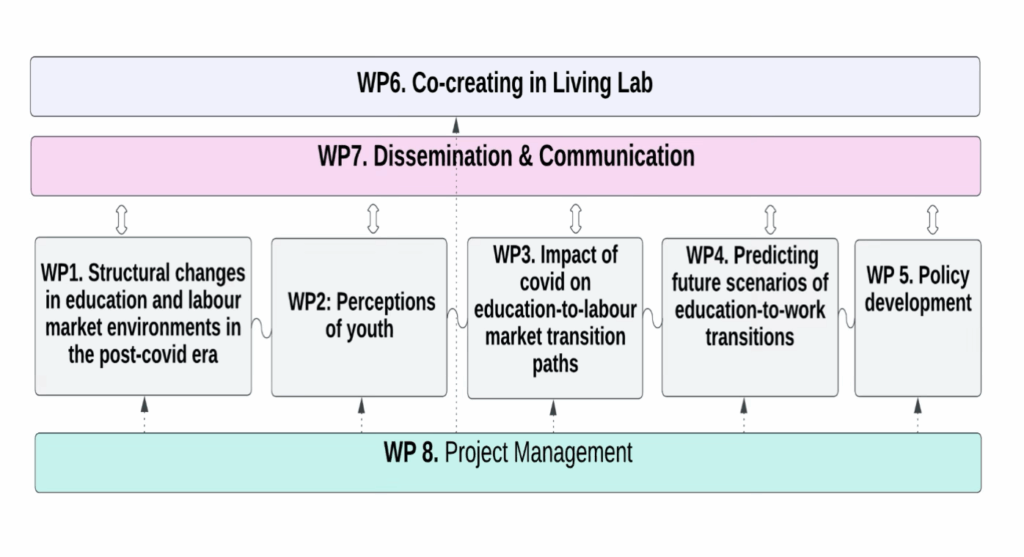
Overview of the work packages
WP1 – Structural Changes in Education and Labour Market Environments in the Post-Covid Era
Work Package 1 explores how the COVID-19 pandemic has triggered lasting changes in education and labour market systems across Europe, with a particular focus on the challenges young people face in transitioning from education to employment. The pandemic intensified trends such as digitalisation, hybrid working, and shifts in skill demands—developments that continue to influence how young people access education and find meaningful work.
WP1 investigates these dynamics through a combination of literature reviews, and empirical data collection. Focus groups with educators and employers in selected European countries help capture how perceptions, practices, and institutional responses have evolved in the post-pandemic context. This includes examining the shift from traditional in-person education to online and hybrid learning models, and how these affect learning outcomes, student engagement, and employability.
In parallel, the work package analyses changes in employer behaviour, recruitment practices, and the structure of work itself, particularly in terms of job stability, skills mismatches, and digital readiness. By connecting insights from both the education and labour sectors, WP1 seeks to map the emerging landscape young people must navigate as they enter the workforce.
A key element of WP1 is the development of an agent-based simulation model that incorporates these findings to explore potential future scenarios and inform policy responses. This modelling tool will help visualise complex interactions between individuals, institutions, and labour market forces.
Ultimately, WP1 contributes to a deeper understanding of how education and employment systems are adapting in a time of rapid change, supporting the development of strategies that can foster more inclusive, resilient, and future-ready pathways for Europe’s youth.
WP2 – Perceptions of Youth
IGOP’s team oversees leading Work Package 2 “Perceptions of youth” which seeks to empirically explore the impact of the COVID-19 crisis on young people’s experiences and perceptions of both horizontal and vertical transitions (Micro-level). During this WP, the UAB team will lead the collection and analysis of about 125 longitudinal qualitative interviews in 5 countries in Europe.
A systematic literature review and two waves of life course interviews will be carried out. Country reports will be issued, and a cross sectional and intersectional analysis will be performed and encompassed in a final comparative country report.
WP3 – Impact of Covid on Education-To-Labour Market Transition Paths
In the NEXT-UP project, Work Package 3 investigates how the COVID-19 pandemic has reshaped youth transitions from education to the labour market (YTSTW) across Europe. Its main goal is to identify emerging patterns and typologies of transition paths, distinguishing them from pre-pandemic trajectories, and to analyse which groups have been most affected. The work package combines large-scale quantitative data from the Eurograduate Survey and the EU Labour Force Survey to explore structural and individual factors influencing transitions.
Key activities include:
- Creating a comprehensive European database on education-to-work transitions before and after COVID-19.
- Developing a cross-national typology of transition paths using advanced statistical techniques.
- Building predictive models to assess how personal and structural factors (e.g., gender, socio-economic background, policy context) shape transition outcomes.
- Conducting intersectional analyses and integrating national registry data to assess medium-term impacts of the pandemic.
WP3 aims to deliver evidence-based insights to support more equitable education and employment policies across Europe.
WP5 – Policy Development
In many post-secondary education systems, successful transition of young people to the labour market (i.e. graduate employability) is one of the key objectives of post-secondary education. Given the importance, governmental (European and national) and higher educational institutional policies and programmes aim to enhance graduate employability.
However, what lacks is an up-to-date – and European oriented – overview and insight into the effectiveness of these policies and programmes, especially in the context changed conditions following the Covid-19 pandemic. To address this gap in our knowledge on policies supporting graduate employability, this work package addresses the following research question:
- What EU and governmental policies and programs of EU-28+EFTA countries were in place to support young people’s transition to the labour market during and post Covid-19 crisis (2019-2022), and what is known about their effectiveness in changing contexts?
The key objective of WP5 is to make national and European policies (i.e., policies driven by EU institutions) on the transition of young people (i.e. graduate employability) to the labour market more evidence-based and fitting for future challenges. The outcomes of the work package will allow policy makers to make knowledgeable choices to this end, while paying specific attention to changing conditions, also in times of crises. Unique in this work package is the focus on making the outcomes as usable to policy makers as possible. Policy makers will also be an essential part of the development, inter alia through their inclusion in the living lab.
WP6 – Co-Creation in Living Lab
Work Package 6 (WP6) addresses the ‘wicked problems’ faced by young people in transitioning from education to employment. Recognising the limitations of traditional top-down policy design, WP6 introduces a participatory, real-life innovation approach grounded in the Living Lab methodology. This approach emphasises co-creation, user-centred design, and reflective dialogue.
WP6 applies the Quadruple Helix model, which brings together key actors from academia, public authorities, industry, and civil society—particularly youth. Through collaborative sense-making and solution design, these stakeholders explore and address structural mismatches in education and labour market systems exacerbated by the COVID-19 crisis, digital transitions, and geopolitical uncertainties.
The Living Lab will operate through a series of onsite (in Tampere) and hybrid co-creation workshops, engaging stakeholders continuously from Month 10 to Month 38 of the project lifecycle. Activities include needs analysis, foresight scenario mapping, policy co-design, and testing of predictive models and simulations. Participatory tools such as the World Café, Foresight Game, and Customer Journey Mapping will facilitate inclusive and reflective engagement.
WP6 aims to generate a replicable social innovation model for enhancing youth employability. It will also foster shared learning across countries, informed by the European Network of Living Labs (ENoLL) framework. Ultimately, WP6 not only co-creates practical strategies and tools with policymakers, educators, and employers, but also empowers youth as active contributors to shaping more responsive and efficient employability policies