
NEXT-UP aims to explore and forecast the long-term impacts of the COVID-19 crisis on the transition of youth from school/education to work/employment (YTSTW), focusing on co-creating evidence-informed, future-oriented policies and programmes, alongside innovative stakeholder engagement. The project emphasises inclusivity, particularly supporting disadvantaged groups for equitable job access.
To achieve the ambitious goal, our interdisciplinary and multi-profile consortium with prominent academic and NGO partners from nine EU countries enhanced with international advisory board, applies interdisciplinary approaches. Our conceptual lens integrates the Quadruple Helix Model for social innovation with concepts of agency between employability and employer-ability, intersectionality, and policy learning, to enhance theoretical understanding. It focuses on the nexus between youth employment policies, stakeholder perceptions, and youth agency in educational and career choices. Methodologically, we innovatively combine the Living Lab approach, machine learning, psychometric surveys, systematic literature review, longitudinal and focus group interviews, statistical methods, agent-based modelling, and policy design.
Triangulating insights from various methods, NEXT-UP fosters a social innovation model to facilitate effective interactions among diverse stakeholders, including policymakers, educators, employers, and youth organisations, to co-create and implement effective strategies for YTSTW. Informed policies and sustained social innovations through NEXT-UP are expected to lead to responsive and resilient educational and employment systems in Europe, innovative educational programmes, and enhanced support for young people entering the workforce. This will significantly impact the formation of social innovation ecosystems to address youth employment challenges in the post-pandemic era and promote social and economic inclusion across Europe.
What we do – Research Questions
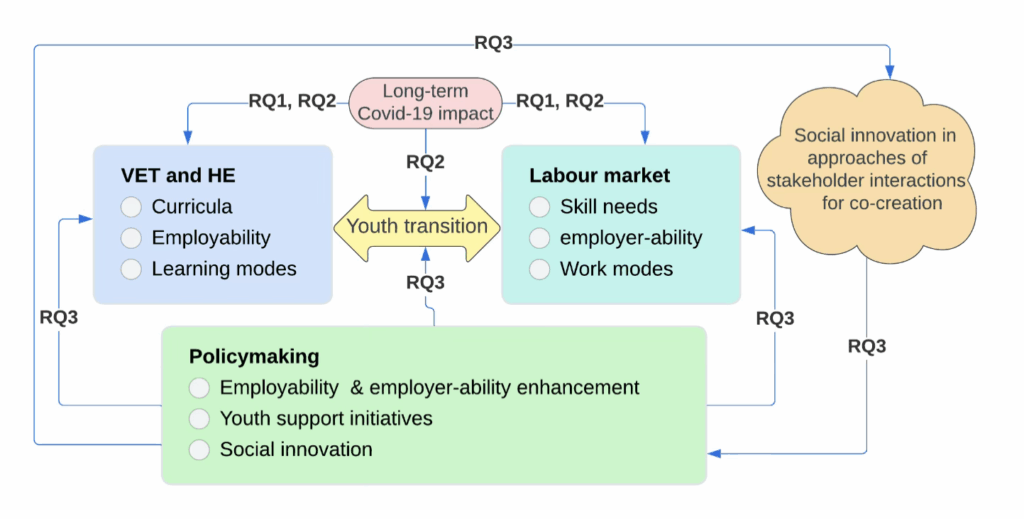
Main concepts and research questions in NEXT-UP
RQ1: How have the societal shifts triggered by the COVID-19 crisis, including changes in educational curricula, learning strategies, labour market skills, modes of working, and governmental policies, affected the YTSTW in the long-term?
RQ2: How have the perceptions and experiences of young people, as well as those of their educators and potential employers, shifted in the post-pandemic landscape?
RQ3: What social innovations can be developed to enhance interactions among stakeholders, such as educational institutions, employers, governments, and youth organisations, to improve YTSTW practices and policies?
Jump to content