
How much do European governments spend on active labour market policies (ALMP) to support young people’s transition from school and into employment? So far, there was no comparable data to answer this question and research interested in measuring policy effort to support unemployed young people had to rely on qualitative indicators (e.g. Tosun, Unt & Wadensjö, 2017) or aggregated ALMP spending – i.e. total expenditure for all age groups – instead (e.g. Cefalo and Scandurra, 2023; van Vugt, Levels & van Velden, 2024).
To address this shortcoming, in the first NEXT-UP Working Paper I propose a novel method[1] of disaggregating Eurostat data on ALMP expenditure by age group (15-24, 25+) and gender based on the measure-level participant data. The method is applied to EU countries and Norway for the years 1998-2023. The data is presented in percent of GDP (Figures 1 and 2) and, to control for different levels of unemployment, in percent of per capita GDP per unemployed person (Figure 3) and by type of ALMP.
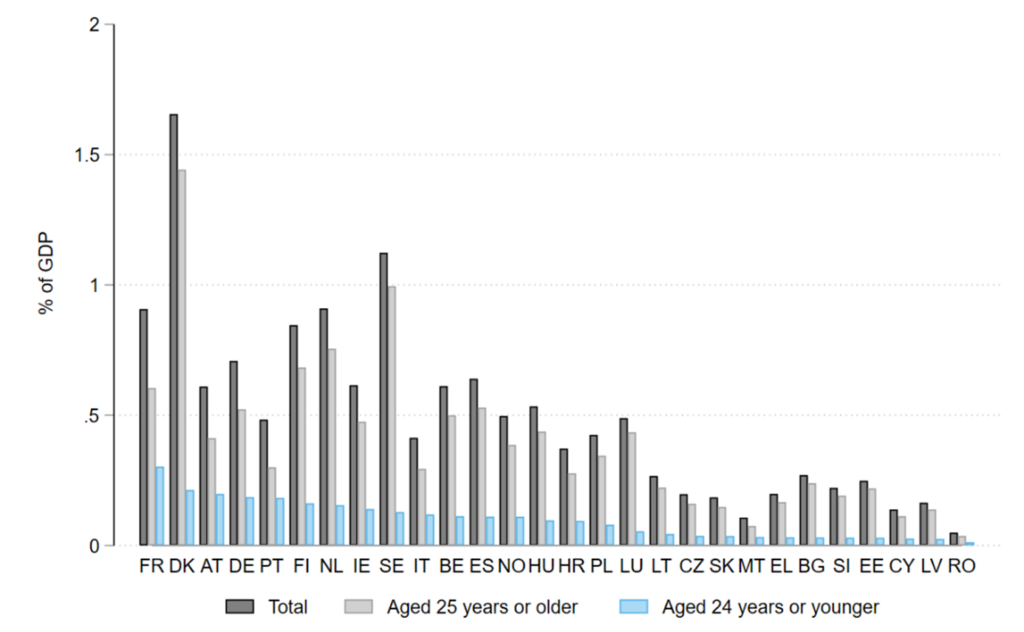
Figure 1: Average spending (1998-2023*) in % of GDP by age group
*Data availability varies between countries. See Geyer, 2026 for details.
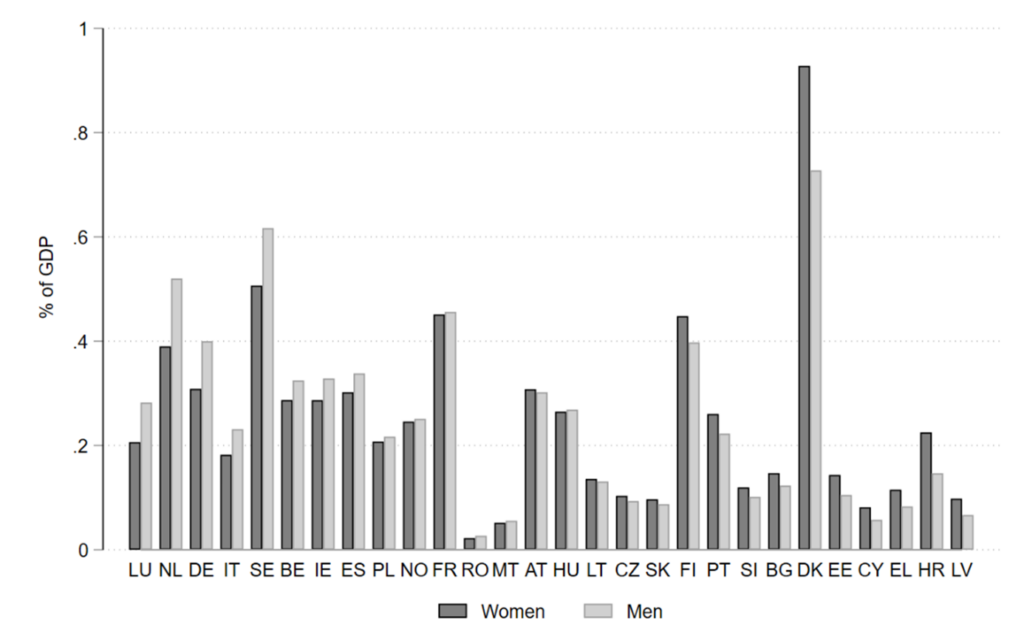
As shown in figure 1, Denmark, Sweden, the Netherlands and Finland (together with France) spent most on ALMP over the last 2.5 decades. However, they allocated only between 12% (Sweden) and 19% (Finland) of their total ALMP budget to measures for young people. In contrast, countries like Austria (32%), France (33%), Malta (31%) and Portugal (38%) dedicated around one-third of their respective budgets to helping youth. Variation in spending by gender (Figure 2) was less pronounced but still visible. The two extremes are Luxembourg, which allocated 58% of its ALMP budget to measures benefiting men, and Latvia, where 60% of spending benefited women.
Figure 2: Average spending (1998-2023*) in % of GDP by gender
*Data availability varies between countries. See Geyer, 2026 for details.
Looking at spending per unemployed by age group (Figure 3), Germany, France and Austria stand out as the most generous towards unemployed young people while Greece, Lativa, Cyprus and Romania spent the least. With respect to the types of measures used, we can see that spending on supported employment and rehabilitation programmes (SSE&R) was mostly higher for older workers, including in Denmark and the Netherlands where it accounted for a significant proportion of total spending on this age group. Expenditure on employment incentives by age group also varied, with most countries – especially Sweden, Luxembourg and the Netherlands – spending more per older unemployed person, and several Central and Eastern European countries – Hungary, Poland, the Czech Republic, Croatia and Slovakia – spending more per younger unemployed person.
Figure 3: Average spending (1998-2023*) per unemployed person by age group
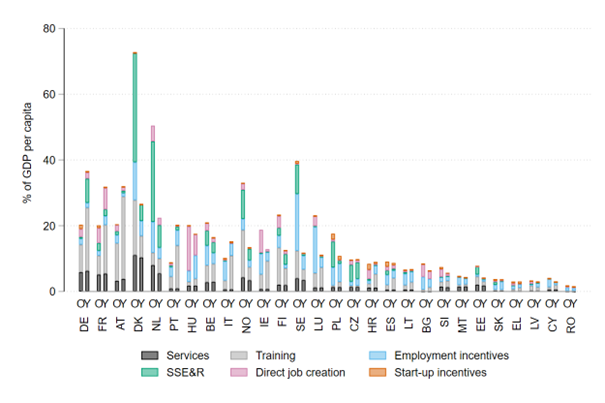
Note: O = individuals aged 25 or older, Y = individuals aged 24 or younger
*Data availability varies between countries. See Geyer, 2026 for details.
Moving from description to explanation, the second interesting finding is that the results do not match power resource theory and Esping-Andersen’s Worlds of Welfare Capitalism (1990) – arguably still the dominant comparative approach for explaining the use ALMP. This theory, which assumes high ALMP expenditure and human-capital oriented policies in the social democratic welfare states of Denmark, Sweden, Finland and Norway, holds well when it comes to labour market policies for older people However, the same countries spent much less on younger people, particularly on training programmes for youth. In contrast, Germany, France and Austria and, to a lesser extent, Portugal, Italy and Ireland stand out as countries with large investments in youth ALMPs, especially training measures. Similarly, power resource theory provides no easy explanation for why Sweden should spend more labour market policy for men while Denmark spent more on measure for women. Thus, new explanations are needed.
Based on these findings, the paper’s central argument is that public expenditure on ALMPs for young and older unemployed individuals, and for men and women, differs from total expenditure, and the latter should thus not be used for research interested in policy effort directed at only one of those target groups
The disaggregated data and the code used to produce them are available online and free to use. So far, this data has been used to explore the political economy of ALMP expenditure targeted at young people (Geyer, 2022) and to explore the use youth employability policies during COVID-19. In general, this more fine-grained data will likely be of most value for comparative studies on the use of ALMPs where it poses new questions – Why do some countries spend more on young unemployed persons and others on older ones? Why do most countries have more generous ALMP for women than for men? – and may help answer some of the remaining unknowns, such as the variation in the human capital orientation of activation policy.
A second field where this data seems useful is evaluation studies, particularly the plentiful analyses exploring ALMPs’ effects on youth (un)employment, which so far have had to rely on arguably inferior indicators for policy effort. Finally, while the focus of the paper is on disaggregation by age group or gender, the same approach can theoretically be used to (further) disaggregate ALMP expenditure for other participant groups on which data is collected. This may include disaggregation by age and gender or unemployment duration to estimate spending e.g. on young men or long-term unemployed individuals. Such further refined data may produce additional puzzles and help advance research in additional fields.
[1] The method was first suggested in my PhD thesis (Geyer, 2022) which focused only on disaggregation by age group.
References:
Cefalo, R., & Scandurra, R. (2023). What, for whom, and under what circumstances: Do activation policies increase youth employment in the EU? Journal of European Social Policy, 33(4), 391 406.
Esping-Andersen, G. (1990). The three worlds of welfare capitalism. Cambridge (Mass.): Polity Press.
Geyer, L. (2022). The Political Economy of Active Labour Market Policy for Young People. PhD Thesis. Otto Friedrich-University Bamberg. Available online at: https://fis.uni-bamberg.de/entities/publication/69b365ca-e59d-439d-9fe7-143837abb5f0.
Tosun, J., Unt, M., & Wadensjö, E. (2017). Youth-oriented Active Labour Market Policies: Explaining Policy Effort in the Nordic and the Baltic States. Social Policy & Administration, 51(4), 598-616.
van Vugt, L., Levels, M., & van der Velden, R. (2024). The low skills trap: the failure of education and social policies in preventing low-literate young people from being long-term NEET. Journal of Youth Studies, 27(2), 217-251.