
José Riega | Tampere University
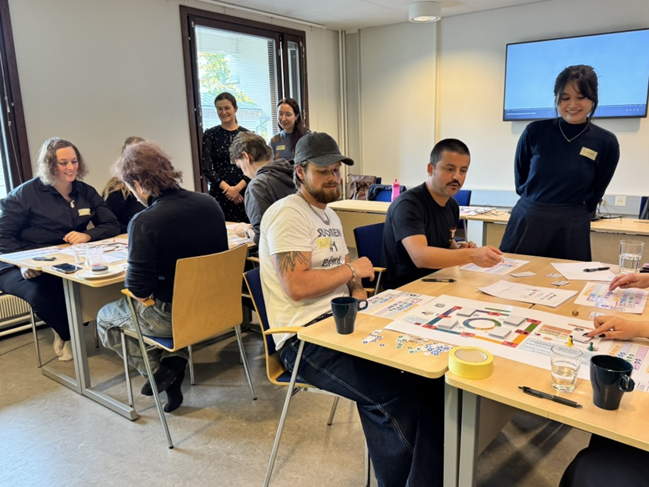
On 9 October 2026, the tables at the National Union of Students in Finnish Universities of Applied Sciences (SAMOK) office in Helsinki were filled with colourful tokens, character cards and different career choices. Participants had gathered to try out the NEXT-UP Employability Game, a board game developed to explore the transition from education to working life. As the game progressed, players gained resources, faced unexpected situations and discussed decisions that could influence their professional paths. Some of these situations were particularly true to life, encouraging the participants to reflect on their own experiences.
The game was developed as part of NEXT-UP, a Horizon Europe research project examining young people’s transitions from education to employment in post COVID-19 Europe. Through its Living Lab activities, the project brings young people and other stakeholders together to discuss challenges and explore possible ways of supporting these transitions.
Understanding employability through different forms of capital
Finding employment involves more than having the right qualifications or completing a degree: personal networks, financial resources, professional recognition and access to opportunities can also influence how people enter the labour market. However, these resources are not equally available to everyone, and their value may change depending on individual circumstances and the broader labour market.
The NEXT-UP Employability Game draws on Pierre Bourdieu’s theory of capital (1986) and its application to graduate employability, particularly the work of Shumilova and Cai (2023) on employability entrepreneurship. Their research discusses how graduates can recognise, accumulate and convert different forms of capital to support their transition into working life.
The game focuses on four interconnected forms of capital: cultural capital, which includes knowledge, skills and qualifications; social capital, referring to personal and professional networks; symbolic capital, associated with reputation, recognition and credibility; and economic capital, which includes money and other financial resources. This approach reflects the idea that resources can be converted from one form into another. For example, educational experiences may help someone establish professional connections, which could later lead to recommendations or employment opportunities. In a similar way, financial resources can make it possible to pursue further education or training.
These conversions may take time, involve costs and depend on the opportunities and circumstances available to each person.
Bringing the theory into the game
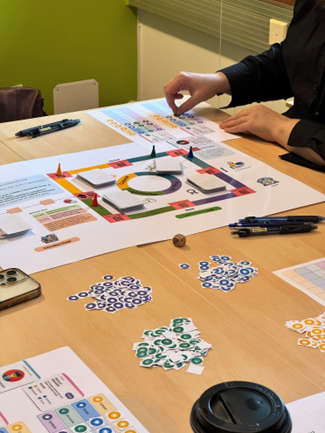
How can these ideas be explored through a board game? In the NEXT-UP Employability Game, each player begins with a randomly assigned character representing a different background and starting combination of resources. Players then select two career goals and begin their journey through education and into the labour market.
Along the way, they collect, lose and exchange capital tokens, encounter opportunities and setbacks, and make decisions about how to use their available resources. Education cards introduce experiences such as internships, courses and mentoring, whereas other cards represent situations that may affect someone’s career development. Some events also involve other players, who can offer support or exchange resources.
Reflection is also an important part of the experience. Certain cards encourage players to discuss their experiences, consider different career decisions or respond to questions raised by other participants. For example, during the Helsinki workshop, one participant asked: “How would you promote entry-level jobs in universities?” Questions like this allowed players to connect situations represented in the game with challenges they recognised beyond the board. Although players compete to complete their career goals, winning is only one part of the experience. The game encourages participants to consider how different resources, personal circumstances and unexpected events can influence the transition into employment.
Developing and testing the Employability Game
The Employability Game has been developed and tested over approximately six months by a team at Tampere University, including Yulia Shumilova, Galina Zvereva, Bernardo Quirola Peñaherrera, Dung Nguyen (Coral) and Yuzhuo Cai. The development process has included designing and adjusting the game mechanics, preparing cards and other materials, and testing the game with participants. More recently, José Riega has contributed to the development of the game materials by preparing the pilot rulebook and instructional videos.
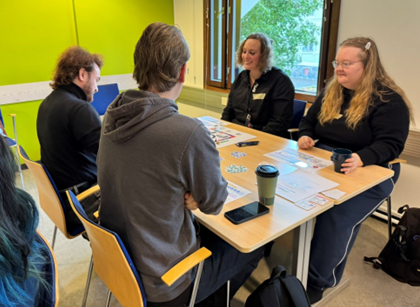
The workshop held at SAMOK on 9 October provided another opportunity to test the game with participants. Playing in small groups, they encountered different situations, shared their experiences and discussed the decisions presented on the cards.
What did participants think?
Following the game, participants came together for a group discussion, where they shared their impressions, experiences and suggestions for further development. Several participants described the situations presented on the cards as realistic and easy to relate to. The reflection cards were especially appreciated, as they encouraged people to share their experiences, discuss common challenges and consider different perspectives on employment.
One participant commented that the situations presented in the game helped them recognise that some challenges are not simply individual problems, but are also influenced by wider systemic conditions. It reflected one of the ideas behind the game, that people’s opportunities in the labour market depend partly on the resources and circumstances available to them.
Feedback collected during the game’s testing process also reflected this connection between the game and personal experiences. One participant mentioned:
“This game is well designed, particularly in its comprehensive understanding of employability and peer interaction dynamics. The integration of these two dimensions provides a meaningful and engaging experience for participants”
Another participant reflected on how the game helped them recognise resources that were already part of their personal development:
“it showed me the 4 essential elements in navigating our own life and for personal growth, which I have been doing but without realizing it”
The participants also shared suggestions for further development. Some questioned the balance between positive and negative events, although their views differed on whether the game contained too many favourable or unfavourable situations. Others suggested introducing more interactive challenges, clarifying certain instructions and adjusting how reflection activities are rewarded. These comments are particularly useful as the game continues to be tested and revised.
Sanja Laitinen-Lindelöf, who joined the workshop, also reflected on the challenges young graduates face when entering working life, including the need to pursue further training or reconsider their career paths. She highlighted suggestions raised during the discussion, such as improving language and cultural learning opportunities, creating more opportunities to build professional networks during studies and increasing the availability of entry-level jobs.
As she observed:
“These discussions reinforced the importance of looking beyond individual job-seeking skills and considering how education and the labour market can better support young people’s transitions into working life”
The NEXT-UP Employability Game remains under development, with feedback from participants helping to improve future versions. The Helsinki workshop also offered an opportunity to discuss how career choices are influenced by personal experiences, available resources and conditions beyond individual control.
Further reading
Bourdieu, P. (1986). The forms of capital. In J. G. Richardson (Ed.), Handbook of theory and research for the sociology of education (pp. 241–258). Greenwood Press.
Shumilova, Y., & Cai, Y. (2023) Employability entrepreneurship for leveraging employability capitals. In T. Broadley, Y. Cai, M. Firth, E. Hunt, & J. Neugebauer (Eds.), The SAGE Handbook of Graduate Employability (pp. 24–44). SAGE Publications. https://trepo.tuni.fi/handle/10024/221788